


The Galaxy S26 Ultra’s pixel-level Privacy Display no longer stands alone.
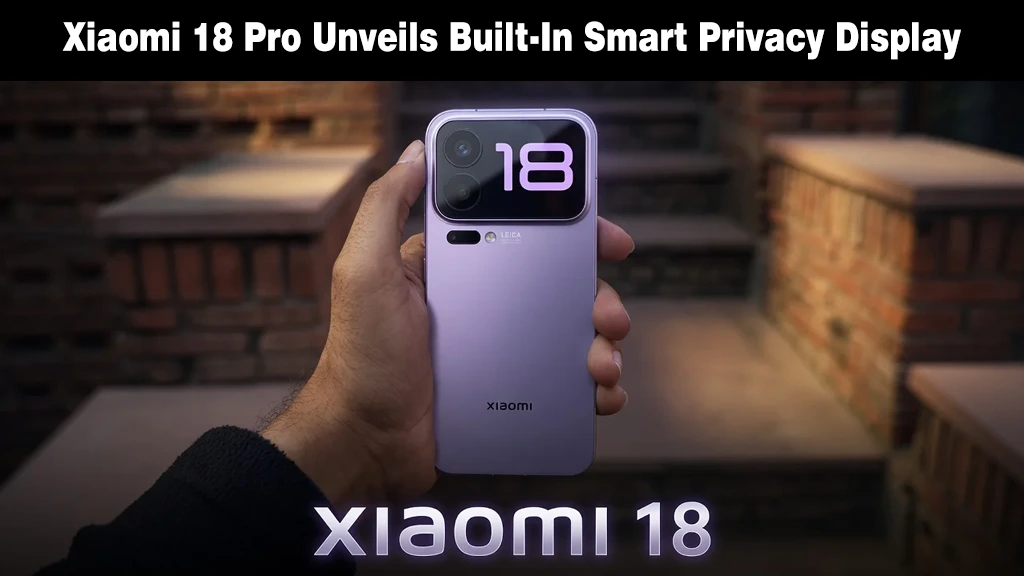
Xiaomi launches its 18 Pro series on September 23, and Android Authority reports the company has now explained how its own version works, using a Weibo Q&A and several announcement posts.
Like Samsung’s, it is built into the panel itself instead of relying on a software overlay. What matters for buyers is whether Xiaomi has avoided the image-quality complaints some S26 Ultra owners raised.
How the Panel Hides Your Screen
As Android Authority details, Xiaomi says that the panel is divided into two alternating pixel sets in a 1:1 arrangement: standard wide-angle pixels and narrow-angle privacy pixels.
The privacy pixels carry microscopic physical baffles on their left and right sides, which restrict how far their light spreads.
In normal mode, both sets light up, and the screen behaves like any flagship OLED.
Switch privacy on, and the standard pixels go dark, leaving only the baffled ones.
From straight on, the view stays unobstructed. Beyond 60 degrees, side brightness drops to roughly 1 percent of the front-facing output, leaving onlookers with a practically black panel.
The technology is currently restricted to traditional flat displays; the Xiaomi 18 Fold and Samsung’s foldables don’t have it.
Where Xiaomi Differs From Samsung
The sharper difference sits in how the subpixels are arranged.
Xiaomi reportedly calls it SuperPixel 2.0 and uses a full RGB stripe instead of the Diamond or Pentile layout. Each pixel gets its own red, green, and blue subpixels rather than sharing them with neighbouring pixels.
Xiaomi claims the 18 Pro Max has roughly 9.5 million subpixels, similar to a conventional 2K panel, while using power closer to a 1.5K display.
Android Authority points out that the S26 Ultra uses Diamond Pentile, with smaller duplicated green subpixels alongside alternating larger red and blue ones.
The panel also uses new M11 luminescent material, offering up to 4,000 nits of peak brightness and full BT.2020 wide-color spectrum support, a hardware upgrade aimed at setting new screen benchmarks for Android phones.
Whether the RGB layout preserves clarity with privacy off remains Xiaomi’s claim until reviewers test it.
Smarter Triggers, Unclear Global Reach
Xiaomi is also leaning on software control.
As Phone Arena notes, Privacy mode can be switched on from Quick Settings, a remapped physical AI key, or Xiao AI voice commands.
Users can set app- or page-level rules, such as banking apps or chat windows, and location rules that activate it at the office or everywhere except home.
The front camera can spot someone looking over your shoulder, then warn you or darken the sides automatically.
Availability is the catch. Android Authority says some 18 series phones are expected to reach global markets, but it is unclear whether Smart Privacy Display will leave China, since that depends on which model is released abroad.
Source: Another Android flagship gets its own take on Privacy Display
