


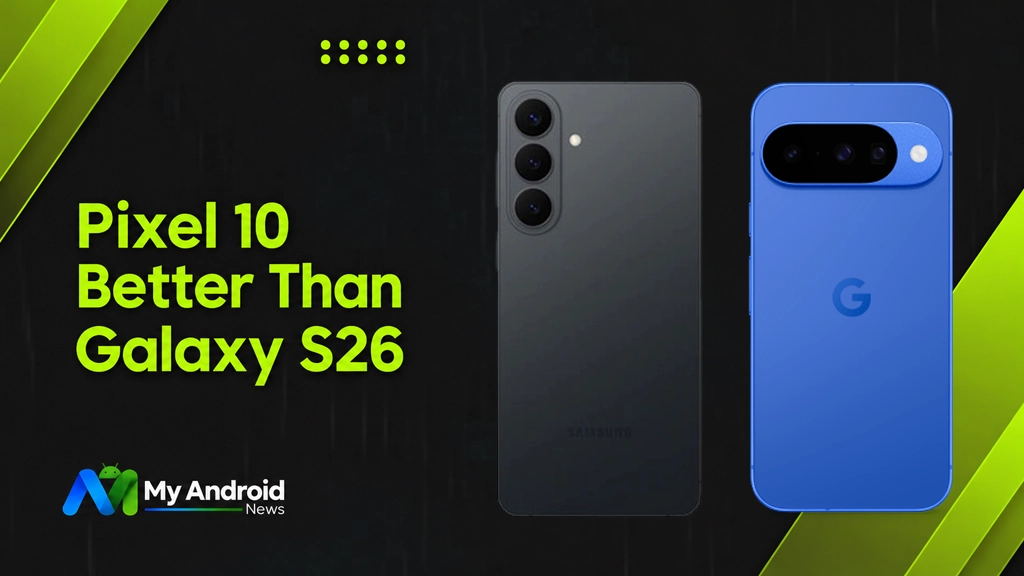
Choosing between Samsung and Google’s latest flagships comes down to what matters most to you: raw power or everyday practicality.
Both the Galaxy S26 and Pixel 10 hit key standards with 12GB of RAM, smooth 120Hz displays, and seven years of software support, and rank among the best Android phones.
However, they focus on very different things. Samsung prioritizes gaming speed and sharp camera hardware, while Google delivers better battery life, extra zoom reach, and lower pricing. This comparison evaluates both models across key areas to see how they stack up.
Pixel 10 vs Galaxy S26: Quick Answer
The Galaxy S26 is the better choice for performance, gaming, display technology, and overall camera performance. On the other hand, the Pixel 10 is better for battery life, lower starting price, 5x optical zoom, and getting Google’s software updates directly from Google.
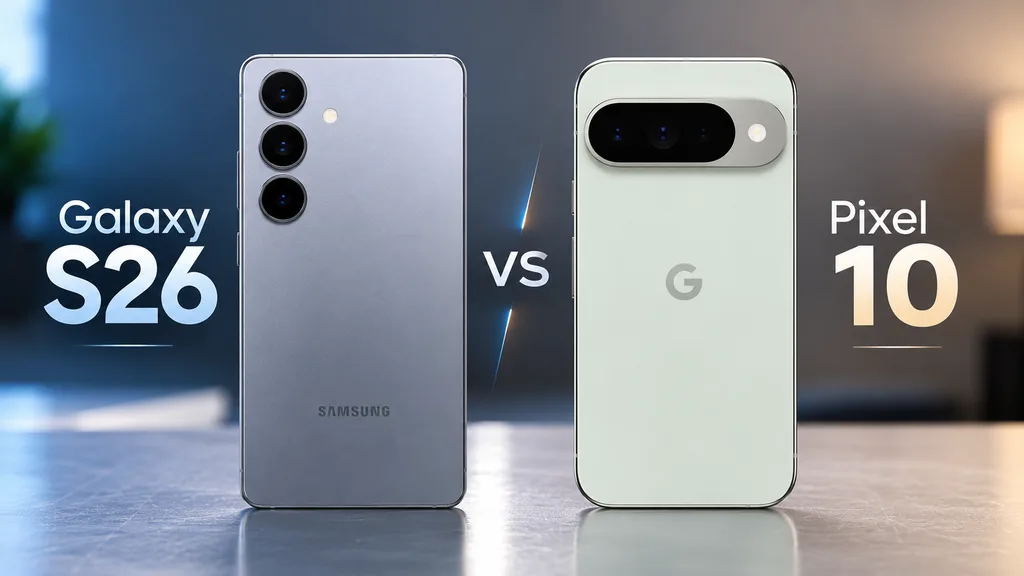
Pixel 10 vs Galaxy S26: Quick Specs Comparison
| Feature | Google Pixel 10 | Samsung Galaxy S26 |
| Starting price | $799 | $999 |
| Display | 6.3-inch OLED | 6.3-inch Dynamic AMOLED 2X |
| Refresh rate | 60-120Hz | 1-120Hz |
| Resolution | 2424 x 1080 | 2340 x 1080 |
| Processor | Google Tensor G5 | Snapdragon 8 Elite Gen 5 for Galaxy |
| RAM | 12GB | 12GB |
| Base storage | 128GB | 256GB |
| Main camera | 48MP | 50MP |
| Ultrawide | 13MP | 12MP |
| Telephoto | 10.8MP 5x | 10MP 3x |
| Battery | 4,970mAh | 4,300mAh |
| Wired charging | Up to 30W | Up to 25W |
| Weight | 204g | 167g |
| Software | Android 16 | Android 16, One UI 8.5 |
| Software support | 7 years | 7 years |
Display
Both phones use 6.3-inch displays, but the important differences are in the backend display technology and refresh rate.
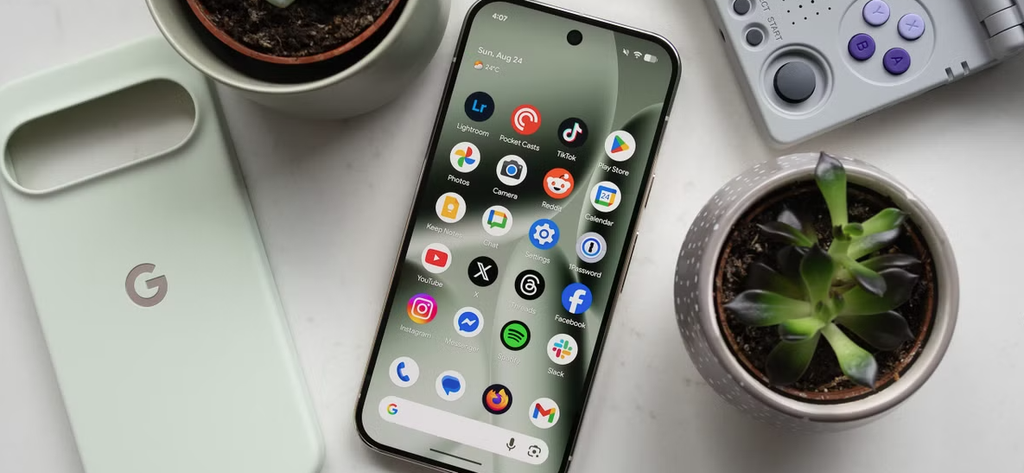
The Pixel 10 has an OLED Actua display with a 2424 x 1080 resolution and a 60-120Hz refresh rate. Google rates it for up to 3,000 nits of peak brightness.
The Galaxy S26 uses an FHD+ Dynamic AMOLED 2X panel with a 1-120Hz adaptive refresh rate and up to 2,600 nits of peak brightness. The 1Hz minimum gives Samsung more flexibility to lower the refresh rate when the screen is displaying static content, which can help reduce battery use.
In practical testing by Tom’s Guide, the Galaxy S26 also produced stronger color accuracy, while the Pixel 10 reached a higher measured peak brightness. The S26’s display appeared to be the stronger overall panel because of its LTPO technology, as the tester notes.
Winner: Galaxy S26
Pixel 10 is indeed brighter, but the S26’s 1-120Hz adaptive panel gives it the more advanced display setup.
Performance
The Pixel 10 and Galaxy S26 both have 12GB of RAM, but Samsung has a clear advantage in raw performance. The Pixel 10 uses Google’s Tensor G5, while the Galaxy S26 uses the Snapdragon 8 Elite Gen 5 for Galaxy or Exynos 2600, depending on the market.
Raw Performance
The Galaxy S26 is significantly faster in benchmark testing. The Snapdragon version scored 3,531 single-core and 10,778 multi-core in Geekbench 6, compared with 2,345 and 6,581 for the Pixel 10.
The graphics difference is even larger. The S26 scored 7,059 in 3DMark Wild Life Extreme Unlimited, compared with 3,425 for the Pixel 10.
Gaming
The Galaxy S26’s stronger GPU gives gaming considerably more headroom for high graphics settings and demanding titles.
The Pixel 10 can still handle everyday mobile gaming, but it is not the better choice if gaming performance is one of your main priorities.
Long-Term Performance
The Galaxy S26’s stronger processor also gives it more of a performance edge for the future. Both phones come with 12GB RAM and seven years of software support, but the S26 has substantially more raw processing and graphics power to work with as apps and games become more demanding.
Winner: Galaxy S26
The S26 has a clear advantage in raw performance and gaming, while both phones are capable of handling normal daily tasks without problems.
Camera
The Pixel 10 and Galaxy S26 both have triple-camera systems, but they approach mobile photography differently.
The Pixel has a 48MP main camera, 13MP ultrawide, and 10.8MP 5x telephoto, while the S26 uses a 50MP main camera, 12MP ultrawide, and 10MP 3x telephoto.
Photo Quality
The Galaxy S26 generally produced brighter and more detailed photos in direct comparisons. The Pixel 10 sometimes produced a more natural-looking background, but Samsung had an advantage in overall detail and brightness.
The two phones are closer with their ultrawide cameras. Samsung produced a slightly brighter image in testing, but the difference is relatively small in normal use.
Zoom
The Pixel 10 has the more capable optical zoom, with a 5x telephoto compared with the Galaxy S26’s 3x telephoto. This makes the Pixel particularly useful for photographing distant subjects without immediately relying on digital zoom.
However, Samsung performed better at higher zoom levels in testing. The Pixel 10’s photos became noisier as the zoom increased, while the S26 retained more detail.
Night and Selfie Photography
The Galaxy S26 also had an advantage in low-light photography. Its night shots are generally brighter and make details easier to see, while the Pixel sometimes produced darker images.
Samsung’s 12MP front camera also produces brighter and sharper selfies than the Pixel 10’s 10.5MP camera in Tom’s Guide’s comparison.
Winner: Galaxy S26
The Pixel 10’s 5x telephoto is useful, but the Galaxy S26 delivers more consistent results across regular photos, low-light shots, and selfies.
Battery Life and Charging
This is where the Pixel 10 has a clear hardware advantage.
Google gives the Pixel 10 a 4,970mAh battery, while Samsung puts a 4,300mAh battery inside the Galaxy S26. That is a 670mAh difference in Google’s favor.
The difference also showed up in battery testing. Tom’s Guide recorded 13 hours and 21 minutes for the Pixel 10 compared with 11 hours and 28 minutes for the Galaxy S26. That is almost two hours of additional runtime for the Pixel.
The S26 did have one advantage during charging. In the same test, it reached 57% after 30 minutes using a 45W charger, while the Pixel 10 reached 52% using a compatible 30W charger. Samsung’s official wired charging specification for the S26 is 25W, while Google rates the Pixel 10 for up to 30W.
The Pixel also supports Qi2 wireless charging up to 15W with its magnetic Pixelsnap system.
Winner: Pixel 10
The S26 can recharge slightly faster in testing, but the Pixel’s much larger battery gives it significantly longer tested endurance.
Design and Weight
Both phones are relatively compact, but the Galaxy S26 is dramatically lighter.
The Pixel 10 weighs 204g, while the Galaxy S26 weighs only 167g. That is a 37g difference despite both phones having 6.3-inch displays.
Samsung’s phone is also only 7.2mm thick. The Pixel 10 measures around 8.6mm thick.
The difference is noticeable when you hold the phones for long periods. The Pixel’s larger battery contributes to its heavier body, while Samsung prioritizes a slimmer and lighter design.
The visual designs are also easy to tell apart. The Pixel 10 retains Google’s horizontal camera bar, while the S26 uses Samsung’s newer pill-shaped rear camera housing.
Winner: Galaxy S26
The S26 is considerably lighter and thinner while maintaining the same 6.3-inch screen size.
Software and AI
Both phones run Android 16 and receive seven years of software support.
The Pixel 10 gets Google’s Android updates and Pixel-specific features such as Gemini, Magic Cue, Camera Coach, Ask Photos, and Circle to Search. The Galaxy S26 uses Samsung’s One UI 8.5 with features such as Now Nudge and other Galaxy AI tools.
The main difference is the overall software experience. Pixel 10 offers a cleaner version of Android with Google’s features, while the Galaxy S26 adds Samsung’s One UI tools and deeper integration with products such as Galaxy Buds and Galaxy Watch.
Winner: Pixel 10
The Pixel gets Google’s Android releases and Pixel features directly, while still offering seven years of software and security updates.
Storage and Price
As of October 2026, the Pixel 10 starts at $799 with 128GB, while you can also buy it with 256GB at $899. The Galaxy S26 starts at $999 for 256GB, with higher storage options offered if you need more storage space. However, prices may vary over time.
That makes the comparison slightly unusual. The Pixel is $100 cheaper at the entry level, but its base model also has half the storage.
If you compare the 256GB versions, the price gap becomes much smaller or disappears depending on current promotions.
The S26 therefore gives you more storage at its entry point, while the Pixel gives you a lower starting price.
Winner: Pixel 10
The lower starting price makes the Pixel 10 easier to enter the flagship market, although the Galaxy S26 gives you 256GB from the base configuration.
Which One Should You Pick?
The Pixel 10 stands out with a larger battery, longer endurance, 5x optical zoom, a lower starting price, and Google’s software. The Galaxy S26 counters with superior processing power, a lighter body, an advanced 1–120Hz adaptive display, and stronger overall camera performance.
Choose the Galaxy S26 if you prioritize gaming, raw speed, display technology, and overall camera quality. Choose the Pixel 10 if battery life, value, and Google’s clean software experience matter most.
